




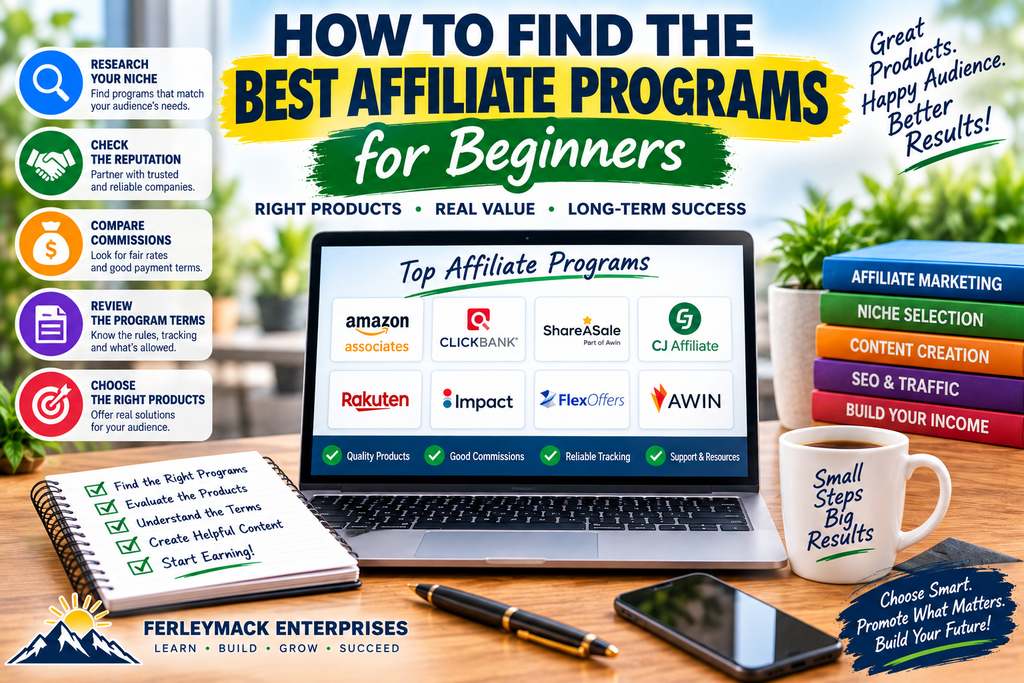
Once you’ve chosen your niche, built your website, started creating helpful content, and learned how to attract visitors, the next step is finding products and services you can recommend.
This is where affiliate programs come into the picture.
There are thousands of affiliate opportunities online, but not every program is a good choice for a beginner—or for your particular audience.
Choosing an affiliate program shouldn’t simply be about finding the company offering the biggest commission. You need to consider the product, company reputation, commission structure, tracking terms, payment requirements, and, most importantly, whether the offer is genuinely useful to your audience.
In this beginner’s guide, you’ll learn how to find the best affiliate programs for beginners and what to look for before joining one.
What Is an Affiliate Program?
An affiliate program is an arrangement where a company allows approved publishers, creators, or marketers to promote eligible products or services using special tracking links.
The basic process looks like this:
Join an Affiliate Program → Receive Your Affiliate Link → Create Helpful Content → Recommend a Relevant Product → Visitor Clicks Your Link → Qualifying Action Occurs → You May Earn a Commission
The exact rules differ between programs.
Some companies pay a percentage of a qualifying sale. Others may pay a fixed amount or use another compensation structure.
Always read the specific program’s terms before promoting an offer.
How Do Affiliate Links Work?
When you join an affiliate program, you’re typically given a unique tracking link.
That link helps the affiliate program identify visitors who came from your content.
For example, you might write an article called:
How to Get Free Traffic to Your Affiliate Marketing Website:
Within that article, you could discuss several tools and provide affiliate links for products you genuinely believe are relevant.
If a reader clicks one of your affiliate links and completes a qualifying action under the program’s rules, you may receive a commission.
Affiliate programs can have different tracking periods, attribution rules, and eligibility requirements, so don’t assume they all work the same way.
1. Start With Your Niche
Your affiliate programs should match your website’s niche.
This sounds obvious, but it’s extremely important.
Suppose your website is about camping.
Relevant affiliate products might include:
- Tents
- Sleeping bags
- Camping stoves
- Hiking equipment
- Outdoor clothing
- Backpacks
- Camping accessories
- Outdoor electronics
Promoting unrelated products simply because they offer attractive commissions can confuse your audience.
Your recommendations should make sense based on why people came to your website.
Think About What Your Audience Needs
Instead of asking:
“What affiliate program pays the most?”
start by asking:
“What products or services does my audience actually need?”
That’s a much stronger foundation for affiliate marketing.
2. Search for Affiliate Programs in Your Niche
One of the easiest ways to discover programs is to search for companies already selling products you would naturally mention in your content.
You can search for phrases such as:
[your niche] affiliate programs
[company name] affiliate program
[product] affiliate program
best affiliate programs for [your niche]
You can also visit company websites and look in areas such as the footer for pages labeled:
Affiliates
Partners
Affiliate Program
Referral Program
Publishers
Be careful with the distinction between affiliate and referral programs. Referral programs may have different rules and may not permit commercial promotion.
3. Look at Affiliate Networks
An affiliate network connects publishers with multiple advertisers or merchants.
Instead of applying to every company through a completely separate system, a network may give you access to many programs through one platform.
Affiliate networks can make it easier to:
Discover merchants.
Apply to programs.
Generate tracking links.
View performance reports.
Track eligible commissions.
Manage payments.
However, being accepted into an affiliate network doesn’t necessarily mean you’re automatically approved for every merchant within that network.
Individual advertisers can have their own approval requirements.
4. Look for Products You Already Know
Think about products and services you already use or understand.
Ask yourself:
What tools do I use?
What products have helped me?
What services would I recommend even without a commission?
What companies serve my target audience?
Starting with familiar products can make creating helpful content easier.
But be accurate about your experience.
If you’ve never personally used a product, don’t claim that you have.
You can still create researched content when appropriate, but make the basis of your recommendation clear.
5. Evaluate the Product Before the Commission
A large commission can look attractive.
But ask yourself:
Would I recommend this product if the commission were smaller?
If the answer is no, reconsider promoting it.
Your audience’s trust is one of your most valuable assets.
A poor recommendation can hurt that trust.
Look at:
Product quality
Customer feedback
Company reputation
Refund policies
Customer support
Pricing
Product usefulness
Potential drawbacks
Alternatives
You want products that solve real problems for the people reading your content.
6. Understand the Commission Structure
Before joining an affiliate program, understand how commissions work.
Affiliate compensation can take different forms.
Percentage Commission
You may receive a percentage of an eligible purchase.
Fixed Commission
You may receive a predetermined amount for a qualifying transaction.
Recurring Commission
Some subscription-based products may pay commissions on qualifying recurring payments, subject to program rules.
Lead-Based Compensation
Some programs may compensate affiliates for certain qualifying leads or actions rather than completed sales.
Don’t assume a program pays for a particular action. Verify the current terms directly with the program.
Higher Commission Doesn’t Always Mean More Money
Imagine two products.
One pays a large commission but almost nobody in your audience wants it.
Another pays a smaller commission but solves an important problem for your readers.
The second product could ultimately be more useful to your business.
Think about:
Relevance + Product Quality + Conversion Potential + Commission
rather than commission alone.
7. Check the Cookie or Tracking Period
Many affiliate programs use a tracking window.
For example, if someone clicks your affiliate link but doesn’t immediately purchase, the program may still attribute a later qualifying purchase to you for a specified period.
The exact duration varies widely.
Some programs use short tracking periods.
Others may use longer periods.
There can also be special attribution rules that determine which affiliate receives credit.
Always read the current program terms rather than relying on old articles or assumptions.
8. Check the Payment Requirements
Before joining, understand how you’ll get paid.
Look for information about:
Minimum payout thresholds.
Payment schedule.
Available payment methods.
Supported countries.
Currency.
Required tax information.
Possible fees.
A program may look excellent until you discover its payment terms don’t work well for your situation.
9. Read the Affiliate Program Rules
This is extremely important.
Every affiliate program has rules.
Programs may restrict certain promotional methods, including:
Paid advertising.
Trademark bidding.
Email marketing.
Coupon promotion.
Social media promotion.
Direct linking.
Domain names.
Incentivized traffic.
Certain types of claims.
Ignoring the rules can result in commissions being denied or your affiliate account being closed.
Read the terms before promoting the offer.
10. Check Whether Beginners Can Get Approved
Some affiliate programs accept beginners.
Others prefer established websites with existing traffic and content.
If you’re starting a new website, don’t become discouraged if you’re rejected by a program.
Keep building.
Publish useful content.
Improve your website.
Build traffic.
Then consider applying again when appropriate.
A website with quality niche-focused content can give merchants a better understanding of how you intend to promote their products.
11. Make Your Website Look Professional Before Applying
Before submitting affiliate applications, make sure your website looks legitimate and useful.
Your site should ideally include:
A clear homepage
Explain what your website is about.
Quality articles
Show companies that you’re actively creating useful content.
About page
Explain who you are and who your website helps.
Contact page
Give people a way to reach you.
Privacy policy
Explain relevant privacy practices.
Affiliate disclosure
Clearly disclose your affiliate relationships.
A half-finished website with little or no content may have a harder time getting approved by certain programs.
12. Find Affiliate Programs Based on Your Existing Content
Here’s another strategy beginners can use.
Look at the articles you’ve already published.
Suppose you have:
How to Build an Affiliate Marketing Website
Products or services that could naturally fit might include:
Web hosting
Website themes
WordPress tools
SEO software
Keyword research tools
Email marketing platforms
Website security tools
Analytics tools
Now the affiliate offer fits naturally into your existing content.
You aren’t creating an article simply because you found a commission.
You’re finding products that complement content your audience already needs.
13. Choose Programs That Give You Content Opportunities
A good affiliate product can create multiple useful article ideas.
Suppose you promote a keyword research tool.
You could potentially write:
Complete Product Review
How to Use the Tool
Product A vs. Product B
Best Keyword Research Tools for Beginners
Is This Keyword Tool Worth It?
Best Alternatives to This Keyword Tool
How to Find Low-Competition Keywords
One relevant product can support an entire group of helpful articles.
14. Don’t Join Too Many Affiliate Programs at Once
Beginners sometimes sign up for dozens of programs.
Then they become overwhelmed.
You don’t need 50 affiliate programs to start.
Consider beginning with a small number of programs closely related to your niche.
Learn:
How the products work.
What your audience wants.
Which content attracts traffic.
Which links get clicks.
Which recommendations convert.
You can expand later.
15. Create Content Before Filling It With Affiliate Links
Your website should provide value beyond affiliate links.
Don’t turn every paragraph into a sales pitch.
A healthy content strategy could include:
Educational guides
Tutorials
FAQs
Problem-solving articles
Product reviews
Product comparisons
Buyer’s guides
Industry information
The reader should be able to learn something useful even if they never purchase anything.
16. Clearly Disclose Affiliate Relationships
Transparency is essential.
If you may earn money when someone clicks or purchases through your affiliate links, clearly disclose that relationship.
Your disclosure should be easy to notice and understand.
For example:
Affiliate Disclosure: This article may contain affiliate links. If you make a qualifying purchase through one of these links, I may earn a commission at no additional cost to you.
The exact disclosure needed can depend on your location, audience, platform, and promotional arrangement, so make sure you follow applicable requirements.
17. Track Which Affiliate Programs Perform Best
Once your website begins receiving traffic, don’t guess about what’s working.
Track your results.
Pay attention to:
Page views
Affiliate link clicks
Click-through rates
Conversions reported by your affiliate programs
Commission amounts
Top-performing articles
Products that receive little interest
This can help you make better decisions about future content.
Don’t Judge a Program Only by Clicks
Lots of clicks don’t necessarily mean a program is performing well.
Look at the complete picture.
For example:
Article → Traffic → Affiliate Click → Conversion → Commission
If an article gets many clicks but few conversions, investigate why.
The product may not match the reader’s needs.
The content may be targeting the wrong search intent.
Or visitors may simply be researching rather than ready to purchase.
18. Review Your Affiliate Programs Regularly
Affiliate programs can change.
A company might change:
Commission rates.
Products.
Tracking periods.
Affiliate networks.
Terms and conditions.
Promotional rules.
Payment requirements.
A program could even close.
Regularly check your affiliate relationships and update your content when necessary.
Don’t leave outdated offers or incorrect information on your website.
What Makes a Good Affiliate Program for Beginners?
When evaluating an opportunity, look for a combination of:
Relevant products
Products should match your audience.
Good reputation
Research the company and product.
Clear terms
You should understand what is and isn’t permitted.
Reasonable commissions
Compensation should make sense for the offer.
Reliable tracking
Understand how qualifying transactions are attributed.
Useful affiliate resources
Some programs provide dashboards, reporting, links, creative assets, or educational materials.
Good customer experience
Remember that you’re sending your audience to the company.
The experience visitors receive after clicking your link can affect their trust in your recommendations.
Questions to Ask Before Joining an Affiliate Program
Before applying, ask:
Does this product fit my niche?
Would this product genuinely help my audience?
Would I feel comfortable recommending it?
What commission does the program offer?
What qualifies for a commission?
How does tracking work?
How and when are affiliates paid?
Are there minimum payout requirements?
What promotional methods are prohibited?
Does the program accept websites like mine?
Does the company have a good reputation?
Can I create multiple useful articles around this product?
If you can answer those questions, you’ll be in a much better position to decide whether a program deserves a place on your website.
Affiliate Programs Are Only One Piece of the Business
Finding affiliate programs can be exciting.
But don’t forget everything that comes before the affiliate link.
You still need:
A niche
A website
Keyword research
Quality content
SEO
Traffic
Audience trust
Relevant recommendations
Think about affiliate marketing like this:
Audience Problem → Helpful Content → Trust → Relevant Product → Affiliate Link → Potential Conversion
The affiliate link is near the end of the process—not the beginning.
Final Thoughts
Learning how to find the best affiliate programs for beginners is an important step in building an affiliate marketing website.
Don’t simply chase the highest commission.
Look for products and services that match your niche and solve real problems for your readers.
Research the company.
Understand the commission structure.
Read the program rules.
Check payment requirements.
Create quality content.
Disclose your affiliate relationships.
Track your results.
Most importantly, protect your audience’s trust.
Affiliate marketing works best when the products you recommend naturally fit the useful information you’re already providing.
Continue Your Affiliate Marketing Training
You’re now building a complete affiliate marketing foundation:
Step 1: Affiliate Marketing Training for Beginners
Understand how affiliate marketing works.
Step 2: Choose a Profitable Affiliate Marketing Niche
Choose the audience you want to serve.
Step 3: Build Your Affiliate Marketing Website
Create your online foundation.
Step 4: Find Keywords for Affiliate Marketing
Discover what your audience is searching for.
Step 5: Write Affiliate Marketing Content That Gets Traffic and Clicks
Create content that answers those searches.
Step 6: Get Free Traffic to Your Affiliate Marketing Website
Start bringing targeted visitors to your content.
Step 7: Find the Best Affiliate Programs for Beginners
Choose relevant products and services to recommend.
What’s Next?
Once you’ve found affiliate programs, your next challenge is getting visitors to actually click your recommendations without turning your website into one big sales pitch.